All Tymeslot features
Scheduling, calendar and video integrations, payments, automation and embedding: everything Tymeslot does, on one page.
See where your bookings come from. Tymeslot tracks visits and conversions on your booking pages with UTM parameters. It sets no cookies, stores no IP addresses and loads no third-party scripts.

Mis à jour le 13 octobre 2026
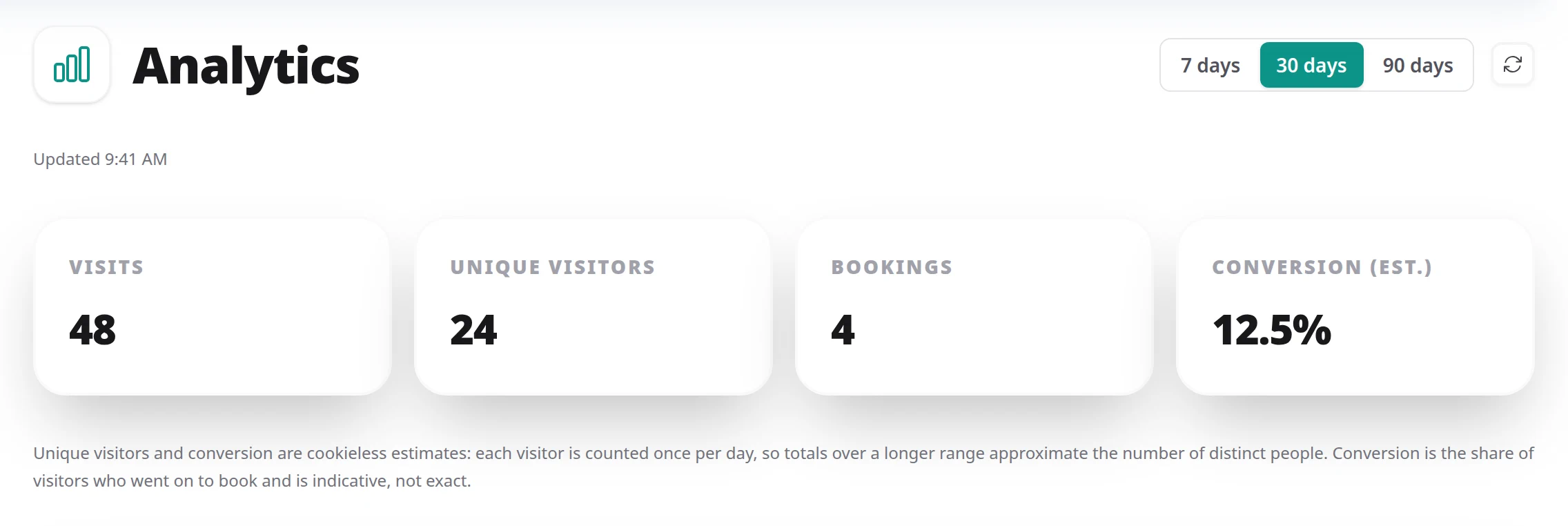
Tymeslot's built-in analytics show which campaigns, channels and partners lead to bookings, not only to clicks. Visits, unique visitors, bookings and a per-source conversion table are recorded on every booking page you publish, and shown under Dashboard → Analytics.
Append
utm_*
parameters to any booking link you share: in newsletters, ads, social posts, partner pages or email signatures. Tymeslot carries UTM and referrer information through the booking flow as long as the visitor follows links from the tagged URL.
The five standard UTM parameters are supported:
newsletter, linkedin, partner-acme).
email, social, cpc).
spring-launch).
A tagged booking link looks like this:
https://your-tymeslot.example/your-handle/intro-call?utm_source=newsletter&utm_medium=email&utm_campaign=spring-launchWhen a visitor lands on one of your booking pages, Tymeslot records one page view with just enough context to attribute the visit, and nothing more.
google.com), never the full URL.
chrome, safari, or firefox, plus whether the device is a desktop, mobile or tablet. No browser version, operating system or device fingerprint.
This list matters as much as the one above. Tymeslot's analytics are built to collect as little as possible, so there is little for a privacy review to find.
Sign in to Tymeslot and open Dashboard → Analytics from the left sidebar. The page covers all your booking pages over the last 7, 30 or 90 days.
utm_source
that sent traffic in the period, with visits, bookings and conversion side by side. Untagged traffic appears as its own row, (direct / unknown). A separate
Devices
breakdown splits visits into desktop, mobile and tablet.
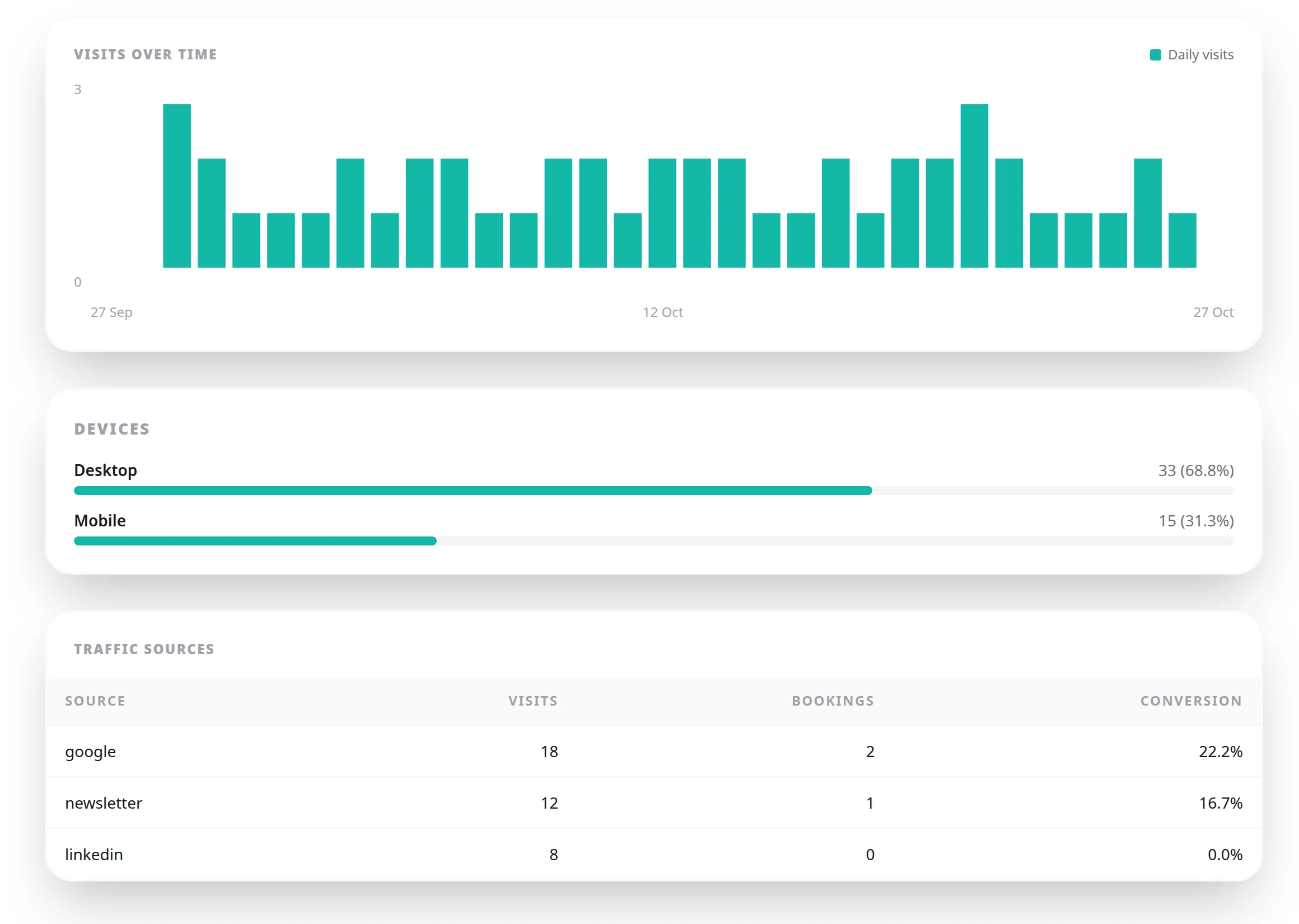
utm_source.
Not on tymeslot.app: tracking is on for every booking page, and the dashboard fills in as soon as you share tagged links. The Analytics page is part of the Pro plan. Self-hosted instances start with analytics off; see the self-hosting question below.
No. The page view is written in the background after the page has loaded, so it never delays the booking flow, and there are no third-party scripts to load.
Not yet. The dashboard combines all your booking pages. Each visit is already recorded with its meeting type, so a per-meeting-type breakdown can be added later.
It's visitors who booked ÷ unique visitors within the selected period: the share of distinct visitors who completed a booking. The dashboard labels it an estimate because the two counts come from separate records; it never shows more than 100%.
Not from the UI today. If you self-host, the underlying analytics_events table
and the utm_* columns on meetings are queryable directly from your own
Postgres.
Booking analytics ships disabled on self-hosted instances. An admin turns it
on under /admin/settings → Analytics → Booking analytics; the change applies
immediately, without a restart. If you build from source,
config :tymeslot, :booking_analytics_enabled, true sets the same default. Review
your privacy policy before you enable it. No secret is needed: each day's
visitor-hash salt is generated at random and deleted once the day is over. Earlier
versions required ANALYTICS_SALT_SECRET; it is no longer read and can be
removed.
Visits and bookings through the widget are recorded, but not attributed to your campaigns. The widget loads your booking page in an iframe and does not pass on the UTM parameters of the page that hosts it. To measure a campaign, share a tagged link to your booking page itself. See the Embed Your Booking Page guide for details.
Scheduling, calendar and video integrations, payments, automation and embedding: everything Tymeslot does, on one page.