Comparison

Tymeslot vs Calendly

Calendly is the best-known scheduling tool. Tymeslot is the source-available, EU-based alternative — first-class CalDAV sync, tracker-free booking pages, and a free plan that isn't capped at a single event type.

Source-available & self-hostable
Unlimited event types — free
Your data stays in the EU
The short version

Tymeslot or Calendly?

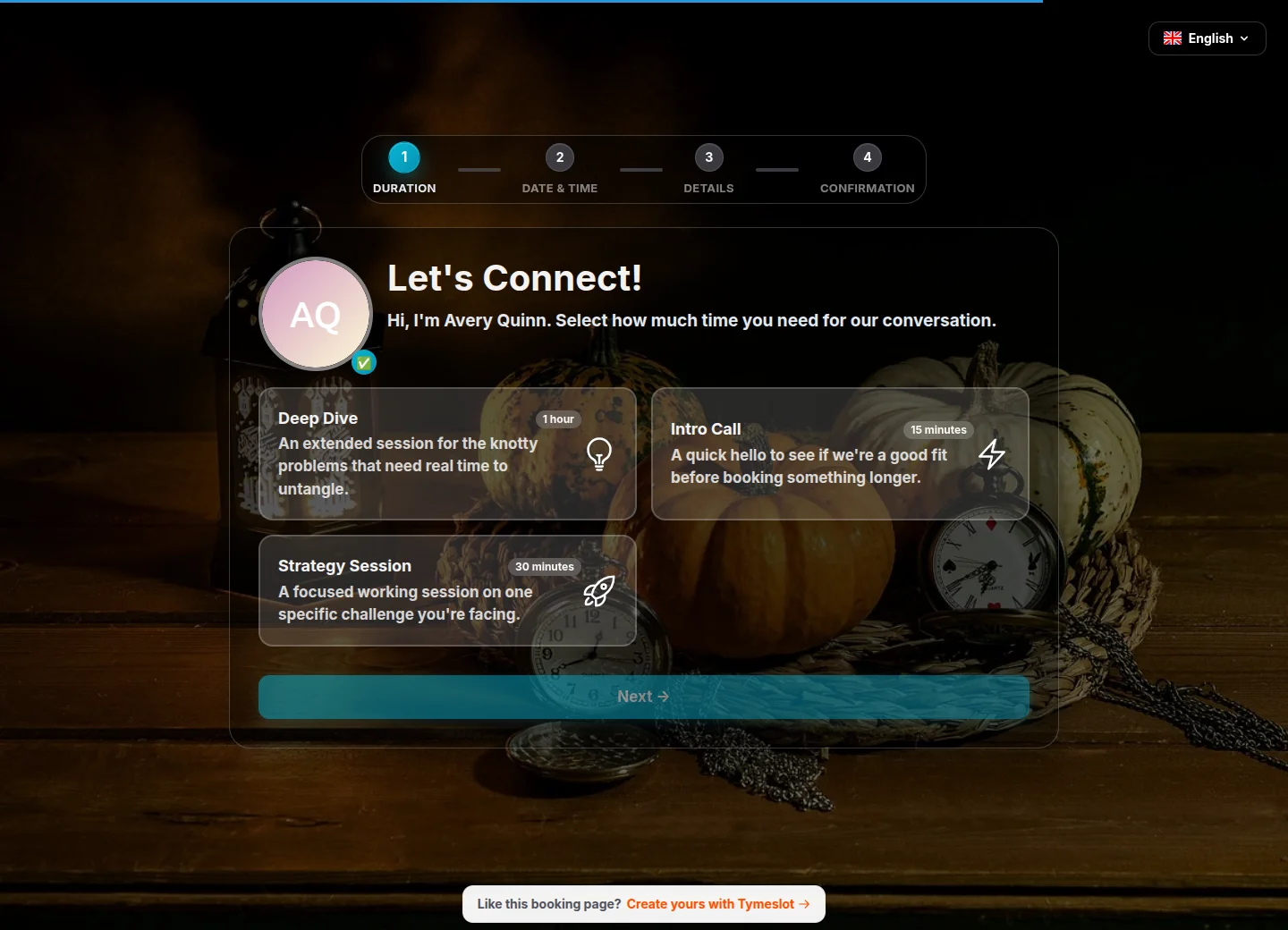
Calendly is a polished, proprietary US SaaS with a huge integration marketplace, a safe default for sales teams that live inside Salesforce and HubSpot. Its trade-offs are a free plan limited to one event type and one calendar, per-seat pricing that climbs with team size, and no way to self-host or keep data in the EU. Tymeslot covers the same core scheduling job (shareable booking links, two-way calendar sync, automatic video links, reminders) but is source-available, self-hostable, EU-based, and treats open calendar standards (CalDAV) as first-class.

Side by side

Tymeslot vs Calendly, feature by feature

The differences that tend to matter when you're choosing between them.

Starting paid price
Tymeslot: Pro €9/mo flat (free plan available)
Calendly: Standard $10/seat/mo (billed annually)
Free plan
Tymeslot: Unlimited event types & calendar connections
Calendly: 1 event type, 1 calendar connection
Licence
Tymeslot: Source-available (Elastic License 2.0)
Calendly: No — proprietary
Self-hosting
Tymeslot: Yes — full feature parity
Calendly: No — cloud only
Generic CalDAV sync
Tymeslot: Yes — Nextcloud, Radicale, Baïkal, Zimbra, mailbox.org
Calendly: No — Apple/iCloud integration only
EU data residency
Tymeslot: Yes — EU-based (Estonia)
Calendly: No — US-hosted (GDPR DPA available)
Pay-to-book (Stripe)
Tymeslot: Pro, or free when self-hosted — fixed fee per event type
Calendly: Standard plan and up (Stripe / PayPal)
Booking themes
Tymeslot: Quill & Rhythm, with dark mode
Calendly: Single branded booking page
Interface languages
Tymeslot: 5 — English, German, French, Italian, Ukrainian
Calendly: Multiple (booking page localisation)
Automation
Tymeslot: Pro, or free self-hosted — Slack, Telegram, webhooks
Calendly: Zapier & webhooks (Standard and up)

Calendly details verified June 2026 — check the vendor's site for current pricing and features.

Where Tymeslot pulls ahead

What you gain by switching

💻

Source-available & self-hostable

Tymeslot's core is source-available under the Elastic License 2.0 and self-hostable end to end — run it on your own server with full feature parity. Calendly is closed SaaS with no self-hosting option.

🔗

Open calendar standards

Tymeslot syncs two-way with any CalDAV server — Nextcloud, Radicale, Baïkal, Zimbra, mailbox.org — as a first-class citizen alongside Google and Outlook. Calendly stops at Google, Outlook and an iCloud integration.

🔐

Tracker-free booking pages

Tymeslot booking pages load no third-party advertising or analytics pixels, and connected calendars only ever expose busy/free — never event details. Ideal for healthcare, legal and other privacy-sensitive work.

🌍

Your data stays in the EU

Tymeslot is built and hosted in the EU (Estonia), or self-host it anywhere you like. Calendly is a US SaaS with a DPA but no customer-controlled EU data residency.

A free plan you can actually use

Tymeslot's free plan includes unlimited event types and calendar connections. Calendly's free plan caps you at a single event type and a single calendar.

💳

Flat pricing, not per-seat

Tymeslot Pro is a flat €9/month. Calendly bills per seat, so cost scales with every person you add.

Our take

Why people move from Calendly to Tymeslot

Calendly nailed the category: drop a link, let people book, sync it to your calendar. For a lot of teams that is enough, and there is no reason to switch for switching's sake.

The friction shows up at the edges. The free plan's single event type pushes most real users onto a paid seat quickly, and per-seat pricing means a five-person team pays five times over. If you keep your calendar on Nextcloud, Fastmail or mailbox.org rather than Google or Microsoft, Calendly simply can't sync it two-way. And because it is closed US SaaS, your booking data lives on Calendly's infrastructure with no self-hosting or EU-residency option — a real blocker for healthcare, legal and public-sector work.

Tymeslot is built for exactly those edges: source-available and self-hostable, EU-based, CalDAV as a first-class citizen, tracker-free booking pages, and a free plan with unlimited event types. You keep the parts of Calendly you liked — the clean booking flow, two-way sync, automatic video links, reminders — without the lock-in.

The verdict

Which one is right for you?

No tool wins for everyone. Here's how they split.

Choose Tymeslot if…

  • You want source-available scheduling you can self-host
  • You keep your calendar on a CalDAV server (Nextcloud, Fastmail, mailbox.org)
  • EU data residency and a tracker-free booking page matter to you
  • You want unlimited event types on the free plan, and flat — not per-seat — pricing

Choose Calendly if…

  • You need Calendly's sales-specific routing (Salesforce lookup, lead qualification)
  • Your team already lives inside Calendly's ecosystem and integrations
  • You want the single largest third-party integration marketplace
Pricing

What each one costs

Tymeslot

  • Self-hosted Free — full feature parity
  • Cloud Free €0 — unlimited event types & calendars
  • Cloud Pro €9/mo (€90/yr) — automation & payments

Calendly

  • Free $0 1 event type, 1 calendar connection
  • Standard $10 per seat / mo, billed annually ($12 monthly)
  • Teams $16 per seat / mo, billed annually ($20 monthly)
  • Enterprise Custom annual contract, from ~$15,000/yr

Calendly pricing in USD, verified June 2026. Per-seat tiers shown at the annual rate; month-to-month is higher. Check calendly.com/pricing for current rates. Tymeslot prices in EUR; VAT may apply.

Migration

Switching from Calendly to Tymeslot

1 Recreate your event types in Tymeslot — same idea as Calendly event types, set up in minutes.
2 Connect your Google, Outlook or CalDAV calendar for two-way, double-booking-free sync.
3 Swap your Calendly links for Tymeslot links everywhere you share them — signature, website, social bios.
4 Optionally embed the booking widget on your site, or self-host Tymeslot for complete data control.
FAQ

Tymeslot vs Calendly — common questions

Is Tymeslot a good Calendly alternative?

Yes — Tymeslot covers the same core job (shareable booking links, two-way calendar sync, automatic video links, reminders, embeds) and adds source-available code, self-hosting, first-class CalDAV, EU hosting and a free plan with unlimited event types. It is the closest source-available Calendly alternative for privacy-conscious users and self-hosters.

Can I import my Calendly event types into Tymeslot?

There is no automatic Calendly importer, but recreating event types takes only a few minutes — each one is just a duration, availability window and a few options. Once created, update your booking links wherever you share them and you're live.

How does Tymeslot's pricing compare to Calendly's?

Tymeslot has a free plan with unlimited event types, and Pro is a flat €9/month (€90/year). Calendly's free plan is limited to one event type, and its paid plans are billed per seat ($10/seat/mo Standard and up, billed annually), so cost grows with team size. Self-hosting Tymeslot is free.

Does Tymeslot work with Apple/iCloud and other CalDAV calendars?

Yes. Tymeslot treats CalDAV as a first-class calendar provider — Nextcloud, Radicale, Baïkal, Zimbra, mailbox.org and other CalDAV servers get the same two-way sync as Google and Outlook. Calendly only offers an Apple/iCloud integration, not generic CalDAV.

Can I self-host Tymeslot instead of using the cloud?

Yes. Tymeslot's core is source-available under the Elastic License 2.0 and self-hostable via Docker, Cloudron or Railway, with full feature parity — including payments and automation that are paid add-ons on the managed cloud. Calendly cannot be self-hosted.

Ready to switch?

Free plan available. No credit card required. Setup in 5 minutes.

No credit card required
Source-available & self-hostable
Privacy-first