Open-source scheduling software, nothing held back
Every scheduling feature of Tymeslot is open source under the GNU AGPLv3. Audit the code, fork it and run it on your own server, or let us run it for you.
GNU AGPLv3
Every feature open source
Self-hosted or managed
With a closed scheduling tool, the vendor controls the code, your clients' names and emails, and what you pay. You cannot check what happens to a booking once it is made, you cannot run the tool anywhere else, and when a plan changes or a feature moves up a tier, you pay or you start again.
Open source shifts that balance. Tymeslot's code is public, so you, or anyone you trust, can read exactly what it does with your data. You can run it on your own server, and if you would rather not, our managed service runs the same code, so you can leave without starting over.
How it works
Up and running in minutes
1
Read the code
The whole product is on GitHub: booking pages, calendar sync, payments, embeds and the admin area. Audit it yourself, or hand it to your security team before you decide.
2
Run it, or let us run it
Self-host with Docker, Cloudron or Railway on infrastructure you control, or sign up for the managed service at tymeslot.app, hosted in the EU.
3
Move between the two
Both run the same code on a standard PostgreSQL database, so no proprietary format stands in the way. There is no self-service export yet; get in touch before you move and we will work out the transfer with you.
What you get
Everything in the open code
GNU AGPLv3 licence
Use, study, change and share the code. The main condition is copyleft: if people use a modified version, including over a network, you offer them its source under the same licence.
The complete product
Calendar sync, video rooms, payments, embeds, themes, webhooks and every interface language are in the open code. None of it is kept back for the managed service.
Self-host your way
Docker on any Linux server, a one-click install from the Cloudron App Store, or a Railway template.
Developed in public
The code, issues and pull requests live in the public GitHub repository, and the public changelog records what each release changed.
No telemetry
A self-hosted install sends nothing back to us: no usage reports and no analytics script, and Google reCAPTCHA stays off unless you configure it.
No per-seat fees
Self-hosted, a whole team shares one instance at no extra cost. You pay for the server, not per head.
Why Tymeslot
What the AGPL means for your business
In plain words, and not as legal advice: for a business that uses Tymeslot to take its own bookings, the licence asks very little.
Using it is free
Run Tymeslot to take bookings for one person or a whole company, with no licence fee to pay and no permission to ask.
Changes stay open
If you modify the code and let other people use your modified version over a network, your clients included, the AGPL asks you to offer them its source under the same licence.
Configuring is not modifying
Choosing themes, colours, settings and integrations in the dashboard leaves the source untouched, so there is nothing for you to publish.
The name stays with us
You are free to fork the code. The Tymeslot name and logo are trademarks, so a fork goes out under a name of its own.
Compare
Open-source scheduling tools compared
How Tymeslot, Cal.com and Calendly answer the questions that matter when you want to own your scheduling. Every competitor fact comes from the vendor's own pages.
Yes, Tymeslot is open source. The code is public on GitHub under the GNU AGPLv3, an OSI-approved licence, and it is the complete product rather than a community edition with features removed. Only tymeslot.app's own billing and marketing pages are private.
Can I use it commercially?
Yes, Tymeslot can be used commercially. A business can run it to take its own bookings without paying a licence fee. The AGPL's main obligation applies when you modify the code and people use that modified version over a network, your own clients included: you then offer them your changes under the same licence. This is a summary, not legal advice.
What is the difference between self-hosting and the managed service?
Tymeslot is the same scheduling product in both. Self-hosted, you look after the server, the database, updates and backups, and every feature is free. On the managed service at tymeslot.app we run all of that for you in the EU, with a free plan and a Pro plan for features such as payments and custom booking questions.
How does it compare with Cal.com?
Tymeslot is open source under the GNU AGPLv3; Cal.com's production code no longer is. In April 2026 Cal.com took its production code closed source, and its free self-hosted option is now Cal.diy, a separate community fork scoped to personal use. The table above and our full Cal.com comparison give the sourced details.
No, Tymeslot does not have to be self-hosted. Sign up at tymeslot.app and our managed service runs the same code for you in the EU. You can move to your own server later; get in touch and we will help with the transfer.
How do I contribute?
Tymeslot welcomes contributions on GitHub. Start with CONTRIBUTING.md in the repository, then open an issue or a pull request: bug fixes, documentation and translations are all welcome. Report security issues privately, as SECURITY.md describes.
Building an open-source Calendly alternative in Phoenix LiveView
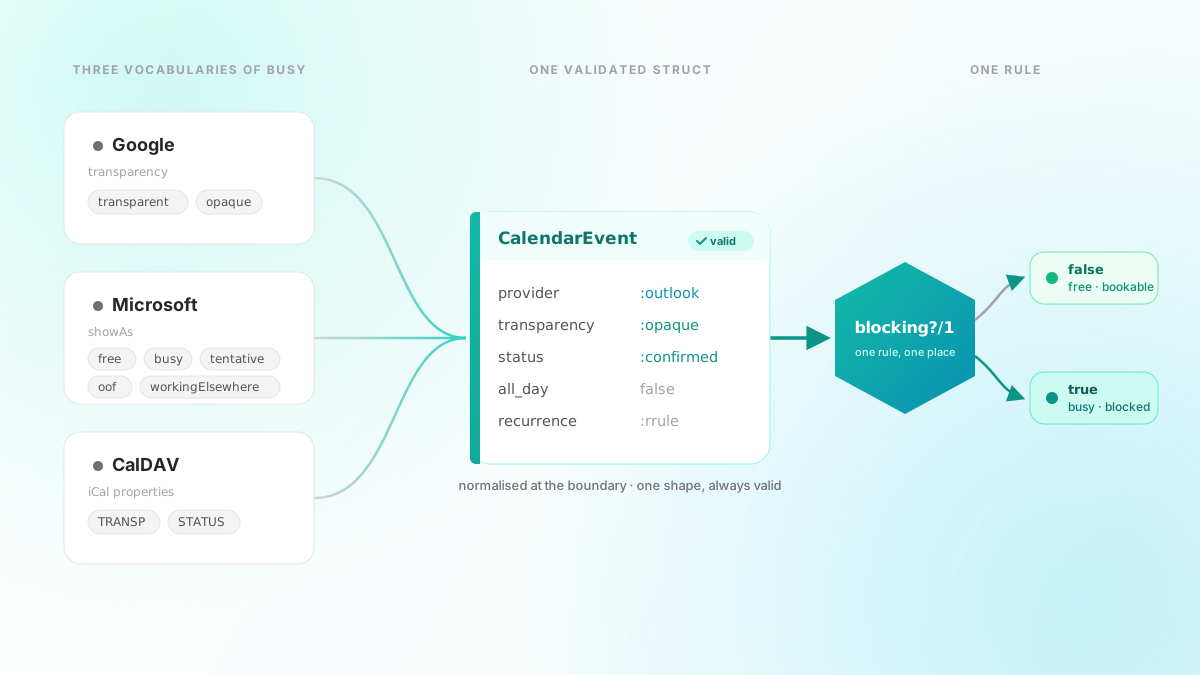
A booking page looks like a form over a calendar. The hard part is that every calendar system disagrees about which events make you busy, and once my code answered that question in two places, the two answers disagreed too.
 Luka Breitig
8 July 2026 · 13 min read